


 Posts
Posts


-
Monday, May 10, 2010
"Get Out of There!"
In honor of the end of the semester, I offer up this video montage, created by Pajiba.com's video editor "hh." I found the theme fitting for an end of year wrap up. Enjoy!
Thursday, April 29, 2010
"What Recession?" Says $40 million in VC Money for Online Video Ads
There are nearly 2 billion internet users worldwide today. Advertisers have taken note - and media companies selling the ads are raking in the bucks...or, rather, pulling in the dough in hopes of accomplishing said buck raking.
Video ad network, Tremor Media, announced yesterday that it completed a round of funding to the tune of $40 million, bringing it's venture capital total to $82 million since the company was founded in 2006. (And who said we are in a recession?)
 This VC round is also notable since Tremor's primary source of revenue is selling pre-roll spots - those approximately 30-seconds of online video that run before you watch your online video. Research firms Magna Global and the Internet Advertising Bureau still show search-based advertising - such as the ads that pop-up on Google post-keyword search - hanging onto nearly 50% of the market share, while digital video ads pick up a comparatively tiny 4%.
Does Tremor and its deep-pocket financiers know something we don't? This apparent confidence in the online video realm suggests they might. Perhaps they are looking into the not-so-distant future when computers and televisions become synonymous.
Personally, I often find online ads...well, bothersome, and I suspect most consumers would agree. Nevertheless, it is a solid competitor in the advertising market. Analysis from the Internet Advertising Bureau, which keeps tabs on the market's trends, shows that Internet advertising revenues in 2009 ranked third, right behind television and newspapers. According to a recent report from research and advertising firm, Magna Global, online advertising is estimated to generate global revenues of over $59 billion dollars this year, up from a "mere" $6 billion in 2000, and growing to $90 billion by 2015.
Video ad network, Tremor Media, announced yesterday that it completed a round of funding to the tune of $40 million, bringing it's venture capital total to $82 million since the company was founded in 2006. (And who said we are in a recession?)
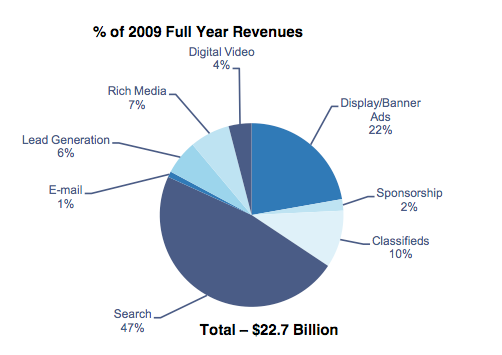
Does Tremor and its deep-pocket financiers know something we don't? This apparent confidence in the online video realm suggests they might. Perhaps they are looking into the not-so-distant future when computers and televisions become synonymous.
Personally, I often find online ads...well, bothersome, and I suspect most consumers would agree. Nevertheless, it is a solid competitor in the advertising market. Analysis from the Internet Advertising Bureau, which keeps tabs on the market's trends, shows that Internet advertising revenues in 2009 ranked third, right behind television and newspapers. According to a recent report from research and advertising firm, Magna Global, online advertising is estimated to generate global revenues of over $59 billion dollars this year, up from a "mere" $6 billion in 2000, and growing to $90 billion by 2015.
Tuesday, April 27, 2010
Hulu to You...for a Fee
To be free or not to be free, that is the question. The Internet is all a-buzz these last few days, following breaking news from The LA Times that Hulu will begin implementing a subscription-only portion of the site, dubbed “Hulu Plus,” as early as next month.
Per the Times, “people with knowledge of the plans” state Hulu, the go-to destination site for viewing television shows online, will begin charging approximately ten dollars per month for access to premium content that goes beyond the most recent five episodes of any given show. By all accounts, Hulu is staying mum for the moment, but since rumors have been circulating for sometime now, whether the pay-service starts in May or sometime down the road, that it will happen, seems all but certain.
Comment threads, upwards of fifty postings long, are littered with people thanking Hulu for the service, but vowing they will leave if forced to pay: “I will never use Hulu again if they add a subscription fee,” “I used to love Hulu but if they start charging then I will definitely stop using it,” “Good bye Hulu, I loved you while it lasted,” are just a few, but representative sample, of how many people feel about the news.
But is it so wrong for Hulu to charge? After all, is there not some value in the content to which Hulu provides access? Don’t we want more access to more shows on the web? Shouldn’t the content creators have a right to receive payment for the work they produce, distribute, and own? Frankly, I don’t see what all the hullaballoo is all about.
“Free” is precisely the reason a vast number of cable productions have opted to keep their content offline: It’s simply worth too much to give it away for free. Unfortunately, “free” is also what many Hulu fans loved so much about the site that has, since its launch three years ago, relied solely on advertising for revenue.
Hulu users are generally divided into two camps: those using the service to catch up on a missed show and those who have abandoned cable service altogether, relying on the site as their primary source of entertainment-dosing. The latter group have generally come to be known as “cord-cutters” – abandoning traditional cable subscriptions in favor of something, well….cheaper.
But good, quality content certainly isn’t cheap – not to make anyway. So, why should anyone expect to have the “right” to consume it when then want it and where they want it at no additional cost? The fee is really two-fold: It puts a price on the convenience and values the content for what it’s worth.
And for those who argue that Hulu’s fee will only drive them to view web content that is free I suspect will soon find that the offerings are far less satisfying. (If you haven’t taken the time recently to peruse some of the vast, truly “free” content on the web, do. You’ll find that most of it is not all that good.) What’s more seem to forget, that only a few years ago, all video content was behind a pay wall: It was called Blockbuster, Hollywood Video, or (insert the name of your preferred rental service here).
Granted, there are a few caveats to Hulu’s plan. Among them, how it will differentiate it’s service offerings from, say Netflix, which already has a monthly “streaming included” subscription service of its own, and how it might expand its slate beyond its current offerings. Regarding the former, Hulu does have a leg up, with its usually next-day release window on television content, while Netflix’s offerings come at more of a lag.
This latter will be likely be more challenging to overcome. It will require negotiation and cooperation with the networks and cable content producers that have been previously wary of offering their content for Internet syndication. However, if Hulu’s successful in that regard, it might truly possess an offering worth paying for.
Saturday, April 24, 2010
Phish...in 3D!

If you're a fan of the legendary jam band, your tickets are likely already burning holes in your pockets for the April 30th wide(er) showing...that is, if you weren't among those lucky enough to catch a pre-screening of the film in select theaters last week.
According to a press release on the film, tickets to the April 20th preview screenings sold out in less than an hour.
The taped concert footage, produced by AEG Network Live and Cinedigm (the same company that piped in the Final Four games to cinemas on the 3rd and 5th), has gotten mixed reviews by the advanced showing attendees...and by mixed, I mean, they either liked it or really, regretted losing hours of their lives they will never get back. Then again, even those not so harshly critical of the production value, were left with a general feeling of ...eh. "For me the novelty of seeing the band in 3D wore off about halfway through the presentation. Watching the film never ceased to be enjoyable, but the initial "wow" factor doesn't sustain itself," said one review.
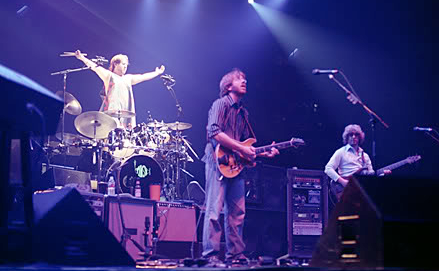
The Wrap's critic was...well...slightly more critical - Not of the band, of course (every follow-up I read unanimously agreed that the music transcended any and all technical failings) but of the editing.
Just as close up shots and quick movements less than impressed those watching the NCAA games in 3D, so too did such cinematic techniques detract from Phish 3D: "The camera jumps around so often – a different angle and distance about every 1.5 seconds or less – that your eyes never have enough time to adjust to the changing depths. Even movie rubes like me know you don’t fill a shoestring 3D movie with quick cuts; it throws the eyes into violent oscillations of depth-perception. And it sucks."
It remains to be seen whether a wider-set of movie goers and Phish fans will have the same reaction following the April 30th release.
Tuesday, April 20, 2010
Conan & Fox, Conan & Fox, Conan & ...TBS?!

Entertainment trades have been reporting since February that Conan is going to Fox: The Wrap had the prenup, LA Times had sources asserting a "viable plan to bring the comedian back to late night."
I was particularly fond of Video Nuze's take on the surprise move: It shouldn't be much of a surprise at all, and merely is a sign of the ever-blurring lines between cable and broadcast television...and the deeper pocket's of broadcast's little brother.
"When it comes to bidding for expensive talent like Conan ($12 million/year reportedly) cable is at a big advantage to broadcast. The recession and ad spending downturn has highlighted the benefits of cable's dual-revenue stream (monthly distributor fees + advertising) model vs. broadcast's ad-only approach."
Video Nuze further offers that the disappearance of "top-tier talent on TV" could be a symptom - and growing one at that - of cord cutting: The more people move away from traditional television, the more the talent we love will be driven to alternative platforms.
What do you think? Post your comments below!
Monday, April 19, 2010
The Salary Battle Royale: Moonves vs. Iger
Forty-three million dollars - that's what CBS Corporation President and Chief Executive Officer, Leslie Moonves, earned last year. A host of reports in the press last week reported that Moonves' total compensation - inclusive of base salary, bonus, and stock options - more than doubled his 2008 earnings.
Nevertheless, at a time when we are scrutinizing executive compensations in the financial sector, should we be extending that analysis to other industries....like entertainment?
Post your comments below!
And who said we're in a down economy?
To put these numbers in perspective, Bob Iger, President and CEO of The Walt Disney Compnay (parent of rival CBS broadcast network, ABC) earned approximately 33% less.
According to proxy statements filed with the SEC, Iger's 2009 compensation summed to $29 million. The package included a base salary of $2 million plus a $9.3 million performance-based bonus (Moonves commanded $3.5 and $15 million, respectively).
Not slim pickings by any means, but if I were Iger, I'd insist the next dinner out is on Moonves.
Nevertheless, at a time when we are scrutinizing executive compensations in the financial sector, should we be extending that analysis to other industries....like entertainment?
Post your comments below!
Sunday, April 18, 2010
On The Line with Tony Gilroy: The Final Draft
A Writer’s Respite
“It’s kind of musical isn’t it?” Tony Gilroy looks back at me, one hand on the window pane, and cracks a genuine Duchenne smile, his every feature engaged.

But it makes sense: Before “Duplicity,” before the Oscar nomination and Directors’ Guild win for “Michael Clayton,” before writing the “Bourne” series, “Proof of Life,” “The Devil’s Advocate,” “Dolores Claiborne,” and “The Cutting Edge” – Tony Gilroy was a musician.
“I can see a career path where I would have been a very mediocre successful record producer,” he says.
Turning onto a quiet brownstone-lined street on Manhattan’s Upper West Side, I was sure Tony Gilroy’s office was within one of the charming, Triassic Sandstone dwellings. (Well, would-be quiet save for the construction crew set up mid-block, machinery whirring away.) But as the numbers tick down to the address I sought what stood before me was a fairly non-descript, flat-front, simple apartment building, not much taller than the brownstones which flanked its either side.
Buzzer only, no doorman. Was it 6F or 6E? I pause and dig through my always-overstuffed bag for the post-it on which I’d scrawled the unit number. Neither. Glad I checked.
The speaker crackles in the way speakers are wont to do, and a voice, which I suspect belongs to my host, invites me up. I’m suddenly nervous. Does he remember me? As I wait for the elevator, I think about the handful of times we’d met. Most of them were on the set of “Michael Clayton,” where I’d worked occasionally as a production assistant. I was so bundled to brave the cold on those days I fear I bore a striking, and not at all flattering, resemblance to the Michelin Man.
Stepping in the elevator, I recall a line from an elegant article in the “New Yorker.” It was something about Tony Gilroy’s “easy smile.” Was that it? Perhaps the line referred to Clive Owen’s character in “Duplicity.” Either way, the smile that greets me when I reach the sixth floor puts me at ease. Mostly. Whether Gilroy remembers meeting me before or not, he doesn’t let on, and we make casual conversation of the sort two old acquaintances might exchange after not seeing each other for a while.
So this is where Tony Gilroy writes. The space is modest, like its exterior: A kitchenette to the right; probably a tiny bathroom off that, perhaps another room beyond. I peek. Perhaps not.
It is a classic New York efficiency apartment, complete with aged wood flooring and moldings layered with decades of paint. It’s low maintenance, sparsely furnished and tidy: Two straight backed chairs; an unimposing credenza on one side; a few framed photographs, others tacked to a corkboard on the opposite wall; a Vornado 660 fan on the floor; a simple bamboo area rug. That’s it. Facing two double-hung windows, a sturdy desk, the dominant fixture in the space, takes center stage. Atop sits a computer. A Dell, an HP? I can’t tell, but it has me transfixed. It holds the key to the burning question: What will Tony Gilroy’s next project be?
It’s a question to which no one has the answer. Perhaps his PC knows, but it’s not telling. Regardless, one can’t help marvel at the fact that a guy who once had so little affinity for educational pursuits came to craft a career from weaving words into compelling stories.
Tilting back in his chair, balanced precariously on one leg, he recalls playing in bands as early as junior high (which he loved) and being miserable at school (which he hated). His scholastic shortcomings prompted teachers to offer him an out during his junior year. “If you’ll shut up and take a couple of extra courses, we’ll graduate you in the spring,” he was told.
By April he was applying to colleges and by fall he was a student at Boston University. “At the time, if you could pay full freight and you were breathing, they would take you. So they took me.” Surprisingly he liked it. And he was good at it, particularly at writing papers – particularly at making money writing papers for other people. “My learning curve was quick.” He smiles again, this one less bright…and infused with a good dose of mischief.
Also quick was his college career: He dropped out during his second year to follow the music. From Boston to Los Angeles and back again, Gilroy was making enough of a living, playing guitar in various bands. Well that, and running a phone scam selling copy toner, “I made a lot of money – selling shit on the phone.” Another mischievous smile.
But then the joy ride began to wind down. There was a missed opportunity with a band that had a shot. There were songwriting deals that began to fall apart. There were habits developed that were…”of the time.” “And sort of cataclysmically, the house that I was living in burned to the ground. I lost everything – literally everything but a guitar. And my car.”

Back under the same roof with his father, Pulitzer Prize winning playwright Frank D. Gilroy, the junior Gilroy began writing more fiction in earnest. He was writing, his dad was writing – He pauses to think about what it was like to be back there. He remembers it felt good. Yet he knew he couldn’t stay forever and hadn’t a clue how he’d ever get back out.
A temporary solution came when he got a deal to start a band based on some songs he’d written. “Temporary” because he was facing a dilemma: He couldn’t pursue both music and writing. For Gilroy, it had to be either/or. So he took the job offer to get into New York City, but ultimately decided to quit music – “cold turkey,” he says. And he never looked back.
Gilroy had been hard at work in the entertainment industry for many years – he wrote screenplays that never got sold, he sold scripts that never got made, and he cringed at some that did get shot, but “fucked up” by those at the helm. Finally he scored big with the one-two punch that was “Michael Clayton” and “Duplicity.” Both were critically acclaimed, both boasted the Apollo Creed-Clubber Lang heavyweight Hollywood equivalents of A-list talent, and both films featured Gilroy as not only writer but director as well.
“I very much wanted to go right away (after “Clayton”) because I didn’t want to get into this ‘what are you going to do next situation’… like I’m in now.”
Now, Tony Gilroy spends his days thinking about what he is “going to do next.” Frankly, so do the many people who worked for him on the previous two films. Not to add undue stress, it’s a simply a testament to the strong, positive and lasting impression he’s made on his crews.
I leave him to his work, though every inch wants to stay a moment more. Just one glimpse…a taste…a hint perhaps? Alas.
Saturday, April 17, 2010
On The Line with Tony Gilroy...Part 4
The financial boon that was “Bourne,” opened new doors Gilroy didn’t know existed: “When you hit it, and all of a sudden the head of the studio’s calling you over the weekend, which you never had before…I thought I was really there, but I really wasn’t. There’s another room here: Another writer’s room. I wasn’t aware of that.”
Tony Gilroy: Writer and Director
Even through the “Bourne’” movies Gilroy also his sights on accomplishing another feat: Directing one of his scripts himself. Why? “I just got sick of directors f***ing up movies,” he says. Fair enough. So, he developed “Michael Clayton” with the intention of sitting at the helm from beginning to end.
His only regret is that he waited so long to go for it.
“I’ve been very careful and very risk averse in a lot of ways, and I should have probably been a director earlier – if I’d been braver and more adventurous. There was another picture before “Clayton” that I really should have done, and it’s a very large regret. I just couldn’t’. I kept saying I wanted to do it, but I didn’t bring the crazy, the real level of passion and insanity that you have to bring to get a first movie made. I just did not. I didn’t fire those extra engines because there was something resistant. For “Clayton,” I did. But it still took five years.”
He took the idea to Castle Rock, who bought it based on what Gilroy calls “a very loosey-goosey idea.” So he set to writing, but that took time – time that found Castle Rock in a different financial position than when Gilroy had begun. “They couldn’t gamble as much as they could when I started it. But they liked it and wanted to maintain the relationship, so they gave it back to me to set it up someplace else.”
For the next four years, Gilroy chased the money, but the money wouldn’t stick until George Clooney entered the picture. “It really finally came down to George.”
And signing with new representation…
“I went to CAA (Creative Artists Agency) and two weeks later, everything started happening,” says Gilroy. “They helped me get the meeting with George. After that it didn’t really matter – anyone would pay for it.”
“I very much wanted to go right away (after “Clayton”) because I didn’t want to get into this ‘what are you going to do next situation’… like I’m in now.”
Now, Tony Gilroy spends his days thinking about what he is “going to do next.” Frankly, so do the many people who worked for him on the previous two films. Not to add undue stress, it’s a simply a testament to the strong, positive and lasting impression he’s made on his crews.
I leave him to his work, though every inch wants to stay a moment more. Just one glimpse…a taste…a hint perhaps? Alas.
Friday, April 16, 2010
On The Line with Tony Gilroy...Part 3
A temporary solution came when he got a deal to start a band based on some songs he’d written. “Temporary” because he was facing a dilemma: He couldn’t pursue both music and writing. For Gilroy, it had to be either/or. So he took the job offer to get into New York City, but ultimately decided to quit music – “cold turkey,” he says.
A New Chapter: Tony Gilroy, the Writer
By that time, his brother Dan had optioned a book in college, written a screenplay and almost got the movie it made. It seemed like a fine idea to Gilroy, “I’ll go write a screen play really quick and I’ll make a bunch of money and then I’ll go back and finish my novel.” In practice, it proved more challenging than he’d thought. And his familial connections didn’t pave a magic road to the top – or a road of any sort except one of encouragement. “I knew William Goldman really well. I think I sent him the second script that I wrote, and he just eviscerated me, but told me to write another one.” So Gilroy did, and he played the game: “sending shit off and waiting to hear from somebody and never hearing back.” And he was getting work as a writer, smallish jobs here and there. “So many weird gigs…” He trails off, appearing almost bewildered by the memory. “You’ll do Aaaanything!” He laughs, remembering one; “I think the guy still owes me like six-hundred dollars.”
Slowly but surely the ball began to roll. He sold his first screenplay (“I quit tending bar right off that check.”), co-written with his “best friend’s girlfriend’s friend” who was a reader at New Line Cinema. He got an agent at International Creative Management, who he met because his co-writer’s father was an agent there. He went on his first trip to Los Angeles, pitching ideas to the studios. He even had a popular romantic comedy script that was making the rounds and getting lots of attention.
Despite connections getting made – Gilroy’s movies weren’t. “You go from just trying to get work, to trying to get something made that’s good, to trying to get something made that makes money to trying to get something made that’s good and makes money.”
Getting Movies Made
But it was an unproduced script that finally got him there. The rom-com making the rounds found it’s way into the hands of producers who came to Gilroy with an idea for what would become “The Cutting Edge.”
Gilroy explains that the industry often wants to pigeon-hole writers, categorize them as either “starters” or “finishers” (Either start a script and the producers will have someone else bring it home, or finish a script that is begging for a strong finale). With “The Cutting Edge,” he proved himself fully capable to be both. From there, he continued shining as a “starter” AND a “finisher,” earning a solid reputation for crafting stories rich with unexpected turns and complex characters on the screenplays that followed…and got made, including “Dolores Claiborne” and “The Devil’s Advocate.”
And then the “Bourne” films? “That whole thing was an accident,” says Gilroy. “Bourne was originally just a gig. I didn’t have any ownership in the beginning, although that changed dramatically.”
What also changed dramatically was Gilroy’s position in the industry: “Having a huge financial success, whether it’s unanticipated or not – and that (“Bourne”) was very unanticipated – that changes a lot of things. I was sort of unaware how much it would change things. Money is just everything.”
The financial boon that was “Bourne,” opened new doors Gilroy didn’t know existed: “When you hit it, and all of a sudden the head of the studio’s calling you over the weekend, which you never had before…I thought I was really there, but I really wasn’t. There’s another room here: Another writer’s room. I wasn’t aware of that.”
Thursday, April 15, 2010
On The Line with Tony Gilroy...Part 2
Gilroy explains that before “Duplicity,” before the Oscar nomination and Director’s Guild win for “Michael Clayton,” before writing the “Bourne” series, “Proof of Life,” “The Devil’s Advocate,” “Dolores Claiborne,” and “The Cutting Edge” – he was a musician...
Musician first, writer second.
“I can see a career path where I would have been a very mediocre successful record producer,” he says.
The thought amuses him. His face brightens with another full smile – every feature engaged. Tilting back in his chair, balanced precariously on one leg, he recalls playing in bands as early as junior high (which he loved) and being miserable at school (which he hated). His scholastic shortcomings prompted teachers to offer him an out during his junior year. “If you’ll shut up and take a couple of extra courses, we’ll graduate you in the spring,” he was told.
By April he was applying to colleges and by fall he was a student at Boston University. “At the time, if you could pay full freight and you were breathing, they would take you. So they took me.” And surprisingly he liked it. And he was good at it, particularly at writing papers – particularly at making money writing papers for other people. “My learning curve was quick.” He smiles again, this one less bright…and infused with a good dose of mischief.
Also quick was his college career: He dropped out during his second year to follow the music. From Boston to Los Angeles and back again, Gilroy was making enough of a living, playing guitar in various bands. Well that, and running a phone scam selling copy toner, “I made a lot of money – selling shit on the phone.” Another mischievous smile.
But then the joy ride began to wind down. There was a missed opportunity with a band that had a shot. There were songwriting deals that began to fall apart. There were habits developed that were…”of the time.” “And sort of cataclysmically, the house that I was living in burned to the ground. I lost everything – literally everything but a guitar. And my car.”
“I was wiped out, he says, “in a lot of different ways.” The fire was an “epic bit of punctuation.” So he went home.
Back under the same roof with his father, Pulitzer Prize winning playwright Frank D. Gilroy, the junior Gilroy began writing more fiction in earnest. He was writing, his dad was writing – He pauses to think about what it was like to be back there. He remembers it felt good. Yet he knew he couldn’t stay forever and hadn’t a clue how he’d ever get back out.
A temporary solution came when he got a deal to start a band based on some songs he’d written. “Temporary” because he was facing a dilemma: He couldn’t pursue both music and writing. For Gilroy, it had to be either/or. So he took the job offer to get into New York City, but ultimately decided to quit music – “cold turkey,” he says.
Wednesday, April 14, 2010
On The Line with Tony Gilroy...Part 1
Oscar-nominated writer/director Tony Gilroy was kind enough to take a short break from his work to talk about the journey that got him to where he is today. While working to shape the interview for my class assignment, I realized what I had was far to epic to use it all for the one piece. BUT, I thought what he had to say was great, and I just love connecting those career dots (it's nice to know that hard work can pay off).
So, without further ado, here's the whole thing - in four "blog-sized" segments! (I'll post my shorter story assignment in a few days).
Enjoy!
-----
Turning onto a quiet brownstone-lined street on Manhattan’s Upper West Side, I was sure Tony Gilroy’s office was within one of the charming, Triassic Sandstone dwellings. (Well, would-be quiet save for the construction crew set up mid-block, machinery whirring away.) But as the numbers tick down to the address I sought what stood before me was a fairly non-descript, flat-front, simple apartment building, not much taller than the brownstones which flanked its either side.
Buzzer only, no doorman. Was it 6F or 6E? I pause and dig through my always-overstuffed bag for the post-it on which I’d scrawled the unit number. Neither. Glad I checked.
The speaker crackles in the way speakers are wont to do, and a voice, which I suspect belongs to my host, invites me up. I’m suddenly nervous. Does he remember me? As I wait for the elevator, I think about the handful of times we’d met. Most of them were on the set of “Michael Clayton,” where I’d worked occasionally as a production assistant. I was so bundled to brave the cold on those days I fear I bore a striking, and not at all flattering, resemblance to the Michelin Man.
Stepping in the elevator, I recall a line from an elegant article in the “New Yorker.” It was something about Tony Gilroy’s “easy smile.” Was that it? Perhaps the line referred to Clive Owen’s character in “Duplicity.” Either way, the smile that greets me when I reach the sixth floor puts me at ease. Mostly. Whether Gilroy remembers meeting me before or not, he doesn’t let on, and we make casual conversation of the sort two old acquaintances might exchange after not seeing each other for a while.
So this is where Tony Gilroy writes. The space is modest, like its exterior: A kitchenette to the right; probably a tiny bathroom off that, perhaps another room beyond. I peek. Perhaps not.
It is a classic New York efficiency apartment, complete with aged wood flooring and moldings layered with decades of paint. It’s low maintenance, sparsely furnished and tidy: Two straight backed chairs; an unimposing credenza on one side; a few framed photographs, others tacked to a corkboard on the opposite wall; a Vornado 660 fan on the floor; a simple bamboo area rug. Facing two double-hung windows, a sturdy desk, the dominant fixture in the space, takes center stage. Atop sits a computer. A Dell, an HP? I can’t tell, but it has me transfixed. It holds the key to the burning question: What will Gilroy’s next project be?
He moves across the room – a quick task, maybe ten paces or so. “Should I close the window? Is it too noisy,” he asks, regarding the construction work on the street below.
Pausing, one hand on the pane, he looks back at me. He cracks a genuine Duchenne smile, “It’s kind of musical isn’t it?” I listen. He’s right. It’s gentler than the typical cacophonic din produced by jackhammers and drills. A melody fills the air, a pitch that slowly rises and falls. Smiling too, I agreed. What a unique observation.
Gilroy explains that before “Duplicity,” before the Oscar nomination and Director’s Guild win for “Michael Clayton,” before writing the “Bourne” series, “Proof of Life,” “The Devil’s Advocate,” “Dolores Claiborne,” and “The Cutting Edge” – he was a musician.
Tuesday, April 13, 2010
Gunning for Win: The battle to be the best online wages on
Late Sunday afternoon, April 11, 2010: Media elite, creative entrepreneurs and entertainment newbies alike gathered at the historic Orpheum Theater in Downtown Los Angeles, California to honor excellence in original online content creation. It promised to be a night celebrating the Internet as both the Great Equalizer and The Future of Entertainment. It promised to be a night to remember. It promised to be one small step for…
Well, actually, whatever Sunday night promised to be, it was one giant leap backward for everyone hoping to elevate the value of Internet content in the eyes of the mainstream and expose a broader viewing audience to the work produced online. It was certainly a night to remember, but one supporters of the medium hope they soon will be able to forget. To borrow the Internet’s word of the minute: Fail.
“When Lisa Kudrow’s producer is standing in line because her ticket can’t be located, you know it’s bad,” said one dismayed attendee. The self-described “plus-one of a star from one of the nominated series,” was appalled and empathetically embarrassed by the disorganization, technical blunders, shoddy production value, and self-deprecating, often grossly vulgar jokes that redefined “un-funny.”
Attempting to offer an upside, the Star Date of the Plus-One said that he was impressed – to a degree: “For an awards ceremony that no one knows about and no one cares about, the audience was full.” But then, “We left halfway through,” he said. “We were bored.”
For every critic of web television, Sunday night proved quite the metaphor for the majority of episodic videos abound on the Interwebs: They are just not working. Only a few years ago, the success of YouTube prompted big money media companies and venture capital-backed startups to create their own destination sites for the express purpose of developing web series. Today, a mere fraction of those is still operating. Very few web series have survived past season one and even fewer have produced enough revenue to let anyone involved bid au revoir to a more reliable Real Job. And that’s a problem, especially if “do what you love and make a living doing it” is the real goal.
As my mother always says, “If you can put a roof over your head, food on the table…and have health insurance, you’ve made it.” Currently, it’s doubtful that for most people, producing online videos will meet Mom’s bar for success.
So, the million-dollar question remains: Why do web series seem perpetually unable to retain an audience? Even if the first installment grabs an appreciable number of eyeballs, why is the overwhelming trend for webisodes to lose viewership in droves?
Whether it’s because of infinitesimal attention spans compared to which that of the MTV generation seem downright glacial; or bothersome technical glitches that often plague the web; or content that isn’t good enough or doesn’t come often enough to rope in a viewer – the jury’s still out. Any way it’s sliced, the end result is the same: There’s no money and therefore no long-term success. The prospects in the world of episodic web-video are indeed grim. Nevertheless, it’s that very, even perhaps minute, nugget of uncertainty, which continues compelling those with a will and a way to wander the Wild West of the webisode world. They are on the Quintessential Quest for a solution to the enigma.
Attention Span Fail: Click, click, clicking away.
Few people dispute that there simply aren’t enough advertising dollars to support the vast array of media platforms gunning for the dough. In the online space, the competition is even greater: Data aggregator eMarketer has reported that brands rarely devote more than 3% of advertising budgets to Internet pushes. Supply is simply overwhelmed by demand: Web video series number in the thousands. Internet content guide Clicker.com lists a hardly exhaustive four thousand six hundred ninety-one original online series to be exact. And of course web series account for a minute fraction of web content in total.
Despite the grim statistics, advertising continues to be the predominant revenue stream in most business models. Taking that as a given, the primary goal of content producers then is acquiring and maintaining an audience. But with so many distractions online – email, facebook, Twitter, Gchat – Internet users click through content at a rapid pace, the multi-taskers that we are. “The results are dramatic: most online video viewers watch mere seconds, rather than minutes, of a video,” posted online analytics firm TubeMogul, following one study observing audience behavior on upwards of 22 million streams. Its findings show that less than 50 percent of viewers watch more than 60 seconds of video. Just under 10 percent stick around for anything longer than five minutes. Most webisodes are longer than three.
According to TubeMogul’s Marketing Director, David Burch, another study was equally damning: “Basically the research took the top 50 professionally-produced, episodic web series and compared total views across episodes from pilot to the eighth.” The conclusion? On average, a whopping 64.31 percent of a show’s premiere viewership never makes it to episode two.
And those are metrics any advertiser shudders to hear.
For Sony’s Crakle.com, it’s been a trial and error game that’s led to the company’s current approach to online video content development. While Crackle initially endeavored to produce web series that could stand on their own and turn a profit, according to Crackle’s Online Development Coordinator Michael Karch, the studio-owned site found it impossible to fully cover its production deficit through advertising revenue alone.
“Our strategy has changed,” says Karsh. Executives at Crackle had noted the success of the 2008’s instant cult classic musical web short, Dr. Horrible’s Sing-Along-Blog. The project, created by TV writer Joss Whedon during the Writer’s Guild strike, was released for free online in three acts, but later successfully distributed for sale on DVD. And that became the inspiration for Crackle’s current model: Producing feature-length projects that are divided into segments for an online “webisode window” and then repackaged for domestic home distribution.
Point well taken: Variable online viewer numbers do not profitable advertising revenue make.
Technical Fail: Still buffering…
Yet another capricious quality of the Internet, whittling away at watcher retention is buggy technology. This is entirely out of the content producer’s control, but nonetheless is a contributing factor to the perception that web television is proving less successful than its mainstream brethren. The Internet has not achieved technological perfection, a point punctuated by the pervasive and perturbing “Buffering” notification. Even more bothersome is “Still Buffering,” often accompanied by a turning wheel or “loading” icon, cajoling the viewer to hang in there, often to no avail.
Once again, TubeMogul offers compelling data: “Re-buffers are commonplace, occurring in 6.84 percent of all streams,” according to the site. “When encountering a re-buffer, viewers click away 81.1 percent of the time rather than wait for the video to re-load.”
Content Fail: Just not Good Enough.
Peripheral distractions and mechanical glitches aside, content creators are not entirely powerless: The crux of any series is theirs to muck up or perfect. No doubt the web is littered with examples of the former. But the latter? The problem here is that few people – even those whose job it is to be an expert in the space – have a firm grasp on which content will lead its creators down the golden path to millions of followers.
This pilot season, one of the most anticipated shows in mainstream television development sprung from an unknown writer, Justin Halpern Tweeting “Sh*t His Dad Says.” “I didn’t think anyone would think it was funny,” says Halpern. But over 1.2 million people have proven him wrong. After Halpern’s friend gave his 140-character blurbs a shout-out one Follow Friday, Halpern’s popularity skyrocketed – from zero followers to over 100,000 in three days. He maintained that traction won with near-daily “words of wisdom,” courtesy of Dad; and now his show is being produced by CBS, directed by the legendary James Burrows (Friends), with a cast led by William Shatner.
Needless to say, Halpern has a roof over his head, food on the table, and health insurance.
But prior to stumbling upon his dream job, Halpern worked for a company that produced viral videos for advertisers. He somewhat prided himself on having a pulse on what would become a runaway hit. But he had not a clue his Tweets would take off the way they did. He says, “It was a little kick in the nuts that I didn’t have any idea.”
TubeMogul’s Burch expresses his bewilderment over the YouTube mega-sensation, Fred Figglehorn. Barely post-pubescent actor Lucas Cruikshank’s webisodes feature himself as six-year-old Fred, mostly monologuing about life with his dysfunctional family. Cruikshank’s brand of humor can be downright morbid. The helium induced-sounding timbre of Fred’s voice borders on obnoxious. And according to Burch, the show is wildly popular among the tween set.
It’s true that the statistics on Fred’s destination site fail to impress: After peaking around 20,000 last year unique views have seen a steady downward trend. However, the series – now in its second season with a Nickolodeon-backed feature film on the way – has YouTube metrics that are off the charts. To date Fred’s Channel boasts 471,634,067 total upload views, nearly 1.7 million subscribers and millions upon millions of webisode streams.
No single celebrity stocked web series – from Lisa Kudrow’s Web Therapy to David Wain’s Wainy Days – funny though it may be, even comes close.
Who would have thought.
Gunning for Win
Along with Fred, although rarely eclipsing his cult-like status, there are a handful of other web television episodic series that do boast millions of views month after month. Eight months ago, the bloggers at Mashable.com teamed up with web analytics pros at the Visible Measures Corporation, to scour the Internet and produce a monthly list of the top ten most watched web shows. The stand-outs of scripted episodics, charting consistently, include the animated Happy Tree Friends; sketch comedy driven Smosh; live-action-meets-animation-meets-gaming hit The Guild; and Red vs. Blue, whose creators lay comic dialogue over images crafted and captured entirely using the game Halo. These are the few, shining examples of web TV that works.
Then again, one could argue that these shows prove that web TV works. Period.
Consider mainstream TV: Per network, hundreds – if not thousands – of shows are drafted, pitched, optioned, written and rewritten each year. Of those, the pilot season process whittles down the choices until a mere few appear on television line-ups in the fall. The whole machine operates behind close doors, out of the general public eye.
Conversely, web television lacks this filtering mechanism, exposing the Fails and Wins for the world to see. Would anyone say that mainstream television is Fail? Probably not. And it’s likely the casts and crews of even the least popular shows would agree. No doubt they have roofs and food and health insurance in abundance.
So the one thing the web permits that mainstream TV does not, is for anyone and everyone to publish their wares and gun for Win.
Doing just that is 25-year-old aspiring writer, director, and producer Matt Vascellaro currently creating his web series offering, Settling. Vascellaro, whose friends say is “obsessed with the equation of what makes TV work – what makes people want to keep watching,” believes quality content in quantity is the key to lasting success on the web.
All too often as the viewer, Vascellaro, has felt abandoned by shows producing less than a dozen five-minute-or-less clips before taking a hiatus. In the light speed-fast pace of the web world, those breaks seem interminable…if the show even comes back. “Why should I really commit myself to viewing anything,” says Vascellaro.
That’s why, when Settling begins “airing” later this spring, Vascellaro will have one hundred shot and edited episodes in his arsenal, laying in wait to be launched daily on the web.
It might work or it might be a big Fail, but at least the Internet gives Vascellaro a space to try. Despite the odds, Vascellaro’s confidence is high and his sheer will is admirable. “At the end of the day, maybe we’ll produce enough good content so that people can’t ignore us anymore.”
Monday, April 5, 2010
3D TV Making Waves in Sports
April 3: Football fans (or soccer to us, irksome as the "misnomer" is to our neighbors 'cross the pond) gathered in 1,000 pubs across the UK and Ireland to watch rival teams Chelesa and Manchester United go head-to-head in a live three-dimensional broadcast of the game.

Several hours later, on this side of the Atlantic, CBS Sports and LG Electronics, along with 3D-leader Cinedigm, beamed the NCAA Men's Final Four semi-finals into 100 digital cinemas across the US.
On the heels of successful 3D film productions, the technology is now making waves with sporting events as well.
Or at least a sizable ripple.
But it seems like a good deal more fun to watch a game at a bar (pub), beer (lager) in hand, and in that respect, for the moment at least, Europe's got us beat. By all accounts, opinions on the 3D showings have been mixed: Overall, people seem enthusiastic about the concept, but less enthused about execution.
I scoured the web to find something other than a glowing press release to get some sense of what it was like to actually experience one of these games in all of their 3D glory.
A report from Harpenden, England (slightly over an hour's train ride north of London's Gatwick Airport) said the pub was packed with fans who squeezed in for the showdown. Post-game reactions were a mix of laments over Manchester United's defeat to comments that the 3D tech, while an excellent idea, still needs some perfecting. My favorite fan quote? "Two of us have got headaches. But we can't work out if they've come from the TV or the amount of lager we've had to drink."
Excellent observation.
On the US side, one reporter noted that the close up camera shots, following a player down the court for example, were less effective in 3D than wider angles and the CBS-generated graphic overlays. The fast, up-close movements often resulted in blurred images that, "made this viewer long for the acuity of an HD picture."

Several hours later, on this side of the Atlantic, CBS Sports and LG Electronics, along with 3D-leader Cinedigm, beamed the NCAA Men's Final Four semi-finals into 100 digital cinemas across the US.
On the heels of successful 3D film productions, the technology is now making waves with sporting events as well.
Or at least a sizable ripple.
But it seems like a good deal more fun to watch a game at a bar (pub), beer (lager) in hand, and in that respect, for the moment at least, Europe's got us beat. By all accounts, opinions on the 3D showings have been mixed: Overall, people seem enthusiastic about the concept, but less enthused about execution.
I scoured the web to find something other than a glowing press release to get some sense of what it was like to actually experience one of these games in all of their 3D glory.
A report from Harpenden, England (slightly over an hour's train ride north of London's Gatwick Airport) said the pub was packed with fans who squeezed in for the showdown. Post-game reactions were a mix of laments over Manchester United's defeat to comments that the 3D tech, while an excellent idea, still needs some perfecting. My favorite fan quote? "Two of us have got headaches. But we can't work out if they've come from the TV or the amount of lager we've had to drink."
Excellent observation.
On the US side, one reporter noted that the close up camera shots, following a player down the court for example, were less effective in 3D than wider angles and the CBS-generated graphic overlays. The fast, up-close movements often resulted in blurred images that, "made this viewer long for the acuity of an HD picture."
No doubt the quality will only improve, as this is only the beginning of 3D event coverage. Europe's Sky TV company boasted an impressive turnout for it's April 3rd event and already has dates lined up for more in the coming weeks and months. Here in the US, the Masters golf tournament was delivered in 3D to Comcast subscribers (well, those who happened to own a 3D-TV) and ESPN will broadcast the World Cup in 3D this June.
Tuesday, March 30, 2010
Video Blogging: A generation of full time...Vloggers
If you were the first person on the block to get a VCR, still refer to your TV's remote control as a "clicker," remember the smell of freshly "ditto-ed" copies handed out in class or recall being tethered to a cord when on the telephone, then you just might not be aware of the online video trend that has become a career for quite a few mid-twenties digital entrepreneurs: Video blogging...better known as "vlogging."
 While this might date me (and my fellow comrades), who consistently swear when someone says "vlog," they are simply mispronouncing (or we are mis-hearing) "blog," it's a fact that the younger set, born post 1985 is far more prolific in their online endeavors than the rest of us.
 According to David Burch, Marketing Director at online research and analytics firm TubeMogul, despite the fact that YouTube will not disclose the details on any of these financial agreements, he estimates the video site makes it well worth it for these twenty-somethings to keep vlogging full time.
 Each day, Helbig shoots, edits and posts her vlogs (it's her only job). She’s the constant among My Damn Channel's site varied video offerings, and her own experience as a viewer makes her well aware of the value her daily presence brings. “People feel like they’ve been let into this world that these people are presenting online,” says Helbig. “When they don’t do a video it’s a letdown. It’s like not being able to hang out with your friend when they had already agreed to hang out with you that day.”
Overhead is low, and with some basic editing skills and computer know-how, it seems like the payoff is not much to scoff at.

Shane Dawson, Phillip DeFranco and Justine Ezarik are just of the few vloggers that have hit YouTube icon status with millions of video views well into the double digits.
And even when they try to leave (several of the top contributors in the vlogosphere have announced "this will be my last YouTube vid" on more than one occasion, but YouTube has a vested interest in keeping the posts a-coming and keeps them hanging on by dangling the golden carrot: ad revenue profit sharing.
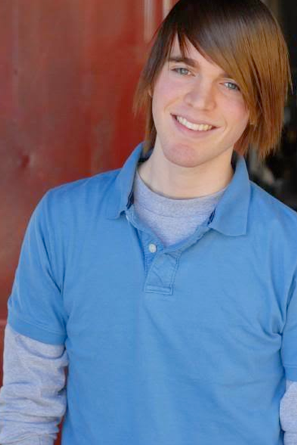
But what is the draw? What keeps millions of viewers tuning in to watch these often random video ramblings? Perhaps its simply that the format is so uniquely in tune with our Internet behaviors. Think about your own internet use: daily (hourly? per minute?) email checks, tweets, facebook comments, ichat convos. Our most regular web activities are tied to applications that provide regular updates of new content. And that's precisely what these vloggers offer.
Unlike webseries (the only other dominant current online video offerings...not including one-off viral videos), vlogs don't typically break for a hiatus while the writer takes time off for a more lucrative, mainstream project. These, I dare say "kids," on online - ever day.
Grace Helbig, the vlogging "face" of webseries studio and platform My Damn Channel, agrees that regular posts are an essential element in the formula for success.

Overhead is low, and with some basic editing skills and computer know-how, it seems like the payoff is not much to scoff at.
Thursday, March 18, 2010
3D TV's Making a Big Splash with Deep Pockets
Two thousand eight hundred ninety-nine dollars is certainly not chump change, but for tech fans and people with money to spare, it is just the right price to place on a home 3D television system.
Or so it would seem, given that it only took one week for Panasonic - the first of the television manufacturers to release a 3D model - to sell out of their in-store US stock.
According to a Bloomberg report yesterday, Panasonic executives couldn't be more pleased. After having sustained losses greater than $111 million in the previous quarter, the unexpected success of the product could make the business profitable once more by this time next year.
 The Panasonic package, which comes complete with 3D Blu-ray player and glasses, seems to be a hit. And this news threatens to debunk BusinessWeek's December 2009 theory that the price tag would deter quick adoption of 3D technology into homes. Already Panasonic is surpassing its own prediction that 3D sets would see "modest sales" in 2010. Although most reports on the subject agree that over the next five years 3D TV sales will grow exponentially, sales in 2010 might just turn out to beat all expectations.
Then again, there are a good number of skeptics out there who believe the Panasonic "sales boom" could be more smoke and mirrors than hard fact. This morning, Fox Business correspondent Clayton Morris was quoted saying, "We don't know the sales numbers yet. If you make 3 of them and you sell them all, that's fantastic...but we don't know the numbers yet on exactly how many they sold."
Perhaps the news was meant to distract consumers from Samsung's unveiling of its own 3D product, which officially went on sale March 14th. There has been little buzz surrounding its release, only that the cost is approximately $400 more than its only current competition.
In June, Sony will add its entry to the home 3D marketplace, predicting 3D TV's in 2010 will account for 10% of its total television sales, per the Bloomberg report.
In addition, Sony is focusing on adding 3D content to its gaming, film and television production, and broadcasting divisions. It's this kind of complimentary business development that will help position Sony to potentially win out over its competitors, despite its delayed at-bat in the game.
So, will you be turning your living room into a 3D entertainment center? Share your thoughts in the Comments below!
Or so it would seem, given that it only took one week for Panasonic - the first of the television manufacturers to release a 3D model - to sell out of their in-store US stock.
According to a Bloomberg report yesterday, Panasonic executives couldn't be more pleased. After having sustained losses greater than $111 million in the previous quarter, the unexpected success of the product could make the business profitable once more by this time next year.

Then again, there are a good number of skeptics out there who believe the Panasonic "sales boom" could be more smoke and mirrors than hard fact. This morning, Fox Business correspondent Clayton Morris was quoted saying, "We don't know the sales numbers yet. If you make 3 of them and you sell them all, that's fantastic...but we don't know the numbers yet on exactly how many they sold."
Perhaps the news was meant to distract consumers from Samsung's unveiling of its own 3D product, which officially went on sale March 14th. There has been little buzz surrounding its release, only that the cost is approximately $400 more than its only current competition.
In June, Sony will add its entry to the home 3D marketplace, predicting 3D TV's in 2010 will account for 10% of its total television sales, per the Bloomberg report.
In addition, Sony is focusing on adding 3D content to its gaming, film and television production, and broadcasting divisions. It's this kind of complimentary business development that will help position Sony to potentially win out over its competitors, despite its delayed at-bat in the game.
So, will you be turning your living room into a 3D entertainment center? Share your thoughts in the Comments below!
Tuesday, March 16, 2010
Hit The Road Jack....er...Conan
I have to say, if I were Conan O'Brien, right now I'd be doing cartwheels: The man who looked like he was getting the short end of the stick over the Jay Leno Experiment / Tonight Show debacle is certainly coming out on top. The events following the early termination from his post as the face of The Tonight Show have proven a financial boon and shown O'Brien to be a class act.
Back in January, MSNBC along with other news outlets reported that O'Brien's exit deal summed to $45 million, approximately $12 million of which he distributed to his displaced staff. For the last months, rumors have grown ever-stronger that the late night host will find a new home on Fox (the LA Times revealed that Fox Cheif Rupert Murdoch hopes to confirm a deal by the May fall line-up announcements, although O'Brien and Co. are carefully weighing their options, including a possible move to a cable network).
Now, O'Brien's 30-city "Legally Prohibited From Being Funny On Television Tour" is proving to be one of the hottest tickets of the year.
Hitting the road is O'Brien's clever work-around to his NBC exit agreement, which blocks him from appearing on television until September. And word is wide-spread across the internet that the monies earned from the dates will be pocketed not by O'Brien, but by his hard-working staff.
Tickets have been selling so fast that second shows have quickly been added to several major stops.
That revenue should nicely pad more than a few severance packages.
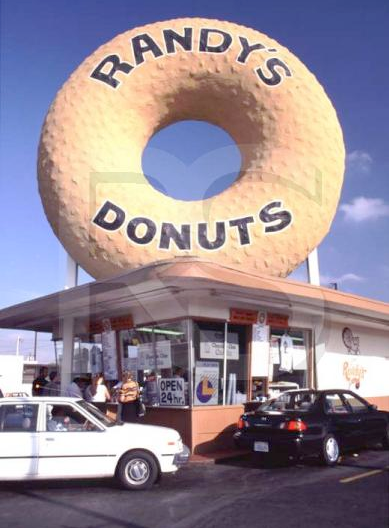
According to O'Brien, his tour preparations are already underway: "First step: Groupie auditions at Randy's Donuts off the 405 fwy. Knock twice on the white minivan." (via Twitter)

I wonder how many donuts Randy sold that day?...
Back in January, MSNBC along with other news outlets reported that O'Brien's exit deal summed to $45 million, approximately $12 million of which he distributed to his displaced staff. For the last months, rumors have grown ever-stronger that the late night host will find a new home on Fox (the LA Times revealed that Fox Cheif Rupert Murdoch hopes to confirm a deal by the May fall line-up announcements, although O'Brien and Co. are carefully weighing their options, including a possible move to a cable network).
Now, O'Brien's 30-city "Legally Prohibited From Being Funny On Television Tour" is proving to be one of the hottest tickets of the year.
Hitting the road is O'Brien's clever work-around to his NBC exit agreement, which blocks him from appearing on television until September. And word is wide-spread across the internet that the monies earned from the dates will be pocketed not by O'Brien, but by his hard-working staff.
Tickets have been selling so fast that second shows have quickly been added to several major stops.
That revenue should nicely pad more than a few severance packages.
According to O'Brien, his tour preparations are already underway: "First step: Groupie auditions at Randy's Donuts off the 405 fwy. Knock twice on the white minivan." (via Twitter)
Wednesday, March 10, 2010
Futures - Coming to Movies Near You
And no, the title of this post refers not to an upcoming cinematic release, but rather, to the financial concept I recently became acquainted with last semester in my Foundations of Finance class.
WAIT! Don't glaze over yet - this is interesting. Some people think it could bring in extra revenue as the movie industry works to overcome losses from continued declines in the DVD/home movie sector.
Reuters reported today that two companies, Media Derivatives and Cantor Fitzgerald, are taking the lead in establishing platforms for investors to trade film futures.
What are futures? I'm partial to examples, and find the use of futures in the airline industry a clear one to follow:
Airlines know, in any given year, that they are going to need fuel - and a good deal of it. An airline might see that gas prices are down and opt to enter into a futures contract with a fuel vendor. Basically, this means that the airline pays today for an asset (in this case jet fuel) that will be delivered in the future. The airline is hedging a bet that fuel costs on the delivery date will be higher than they were on the day of purchase. If that proves true, the airline saved money by trading jet fuel futures.
This is likely an over-simplified explanation, but you get the idea.
Apparently, film futures will work in a similar way: "...if the expected box office revenue of a film is $170 million, an investor could buy a futures contract for $170 and, if the movie does better than expected, could sell at a higher price," said Cantor in the Reuters' piece.
In other words, investors in film futures would benefit from the difference between a lower price paid today and a higher price asked in the future, just as the airline in the example above.
The benefit for the studio behind the film is the potential to limit any downside. Per Reuters, "Hollywood studios often bring in partners to invest in their movies and minimize their risk. A futures market could give producers another measure of protection."
It is unclear at which stage of a film's production futures will be offered. However, it seems possible that if they're made available during development, futures could help with the financing. As I discussed in an earlier post, in the last several years, producers have been struggling to fill a gap left by "falling foreign dollars" (read about that HERE).
Media Derivative's Trend Exchange plans to start trading by the summer and Cantor Fitzgerald as early as the end of April.
For the full Reuters' story, click HERE.
...Ain't it grand when you find you can apply recently acquired knowledge to real world applications?!
Then again, maybe this J-School Grad just doesn't get out enough these days...
WAIT! Don't glaze over yet - this is interesting. Some people think it could bring in extra revenue as the movie industry works to overcome losses from continued declines in the DVD/home movie sector.
Reuters reported today that two companies, Media Derivatives and Cantor Fitzgerald, are taking the lead in establishing platforms for investors to trade film futures.
What are futures? I'm partial to examples, and find the use of futures in the airline industry a clear one to follow:
Airlines know, in any given year, that they are going to need fuel - and a good deal of it. An airline might see that gas prices are down and opt to enter into a futures contract with a fuel vendor. Basically, this means that the airline pays today for an asset (in this case jet fuel) that will be delivered in the future. The airline is hedging a bet that fuel costs on the delivery date will be higher than they were on the day of purchase. If that proves true, the airline saved money by trading jet fuel futures.
This is likely an over-simplified explanation, but you get the idea.
Apparently, film futures will work in a similar way: "...if the expected box office revenue of a film is $170 million, an investor could buy a futures contract for $170 and, if the movie does better than expected, could sell at a higher price," said Cantor in the Reuters' piece.
In other words, investors in film futures would benefit from the difference between a lower price paid today and a higher price asked in the future, just as the airline in the example above.
The benefit for the studio behind the film is the potential to limit any downside. Per Reuters, "Hollywood studios often bring in partners to invest in their movies and minimize their risk. A futures market could give producers another measure of protection."
It is unclear at which stage of a film's production futures will be offered. However, it seems possible that if they're made available during development, futures could help with the financing. As I discussed in an earlier post, in the last several years, producers have been struggling to fill a gap left by "falling foreign dollars" (read about that HERE).
Media Derivative's Trend Exchange plans to start trading by the summer and Cantor Fitzgerald as early as the end of April.
For the full Reuters' story, click HERE.
...Ain't it grand when you find you can apply recently acquired knowledge to real world applications?!
Then again, maybe this J-School Grad just doesn't get out enough these days...
Subscribe to:
Posts (Atom)